

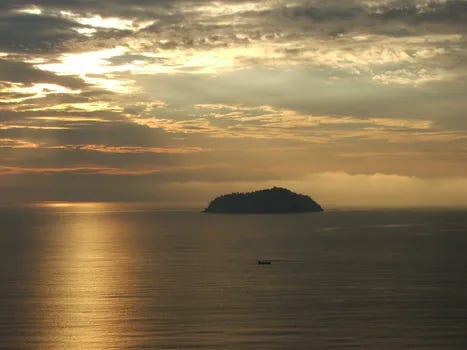
They told us, no, convinced us, that we needed to join this expedition. That we were the last hope for the Human race. They told us the stories of the of ghost ships running ashore full of some kind of rot. Crews reduced to stains on bulkheads. Radios whispering nonsense lang after power should have died. Cargo holds sealed from the inside.
They showed us photographs. Blurred satellite images of a shape in the ocean that hadn’t been there a year before. A bruise on the blue of the Pacific. An island that did not obey tectonics or weather patterns. An island that appeared only when it wanted to be seen.
“NU,” they called it.
Not new. Or North. Not even nautical.
Just NU.
No explanation.
They said the old systems were failing. Crops were dying. Oceans were warming faster than models predicted. Microplastics in blood. Prions in soil. Viruses evolving faster than vaccines. Every year another quiet collapse, another emergency renamed “temporary.”
NU Island, they claimed, was different.
Untouched.
Pure.
A genetic vault. A refuge. A second start.
They needed volunteers.
They didn’t say test subjects, but we all heard it anyway.
The ship was called Icarus.
Someone in public relations must have thought it sounded heroic—a symbol of daring, of reaching higher than anyone before.
No one mentioned how that story ends.
The Icarus was an old research vessel stripped down and rebuilt until she barely remembered what she had once been. Her hull was patched like a scarred animal. Her corridors smelled of disinfectant and warm metal. Every surface hummed faintly.
We were ninety-seven people: scientists, engineers, doctors, soldiers, and a few “generalist” like me—writers, teachers, translators. People whose job was supposedly to remember what being human meant.
Or to record how we lost it.
I joined because my city was gone.
One winter, people stopped coming back from work. Stores closed. Trains ran without passengers. Apartments sat lit and silent. My neighbor’s dog barked for three days before someone noticed.
There was no plague. No announcement. Everything just stopped.
So when they offered me a place on a ship headed toward something unknown, I said yes before they finished the sentence.
Three weeks out, the ocean began to flatten, not calm but emptied—like something had pressed a hand over the surface and smoothed every ripple. The crew stopped pretending not to notice. Conversations thinned. Footsteps softened. Even the gulls that had followed us for days peeled away one by one.
The water lost its smell first. No salt, no algae, no life. When the wind shifted, it carried nothing—no taste on the tongue, no sting in the eyes. The biologists ran tests, but the samples came up blank, as if the ocean had been rinsed clean of itself.
People started sleeping less. Or said they did. Meals went untouched. The ship’s doctor started making rounds at night, checking pulses, asking questions no one wanted to answer. The hum in the walls grew louder, though the engineers insisted nothing had changed.
By the fourth night, even the clocks seemed uncertain. Digital readouts drifted by a few seconds, then corrected themselves, then drifted again. The captain ordered manual timekeeping, but the watches disagreed too—each one ticking at its own pace. No one said the word “anomaly.” we just moved slower, spoke softer, as though hurrying might draw attention from whatever waited ahead of us.
The first sign came at dawn, though most of us were already awake. The light hit the water at a strange angle—too low, too sharp—casting reflections that didn’t line up with the sun. The surface looked laminated, almost as if a second ocean lay just beneath the first, slightly misaligned. When the ship cut through it, the wake didn’t behave. It folded in on itself, closing almost instantly, leaving no trace we’d passed at all.
One of the deckhands leaned over the railing and swore the water felt thicker, not viscous exactly, but denser, like it was holding its shape around his fingers. He pulled his hand back quickly, wiping it on his pants even though it came up dry.
We told ourselves we were the first to see it. The first to cross whatever threshold we’d slipped into. But the ocean didn’t react like it was greeting anyone new. It felt... practiced. As if it had been waiting for us specifically, adjusting itself around our hull the way a body shifts in sleep when someone sits on the edge of the bed.
But you could see it in the way people stood at the railings—backs straight, hands braced, like they expected something to rise from beneath and take attendance.
Landfall should have felt like relief. The moment the keel scraped the shallows, the ocean regained its texture—waves lapping, wind carrying salt again, gulls circling overhead as if they’d been there the whole time.
The air smelled normal. The light behaved. Even the clocks synced without anyone touching them. People laughed, actual laughter, the kind that comes from realizing you’ve been holding your breath for too long.
We set up camp along the tree line: canvas shelters, a comms tent, a perimeter of motion sensors that chirped cheerfully when tested. The soil was rich, dark, almost soft. the botanists knelt in it like pilgrims. the soldiers relaxed their shoulders. Someone played music from a portable speaker.
For the first time in weeks, the hum in my teeth went quiet.
A geologist names Ramos. His cot was empty, his boots gone, his datapad still charging beside the pillow. There were no signs of struggle. No tracks leading away from the camp. The motion sensor hadn’t triggered. The comms officer insisted he must have wandered off to take readings early, but no one believed that. Ramos hated mornings.
By noon, a second person was gone. A soldier this time. Her rifle still racked, her pack untouched. She’d been on perimeter duty. The sensor logs showed nothing.
The island stayed quiet. Birds calling, Leaves rustling in the breeze. Sunlight filtering through the canopy like any other untouched place on Earth.
It was the normalcy that frightened us most.
We formed a search team at the next light—eight of us, armed but pretended not to be. The forest was easy enough to move through, the undergrowth sparse, the air cool and clean. We called Ramos’s name until the syllables lost meaning. No answer. No birdsong either, not anymore. Just the soft percussion of our boots and the occasional crack of a branch settling under its own weight.
About an hour in, we found the first sign. Not a body. Not even a struggle. Just the strip of fabric tied neatly around a tree trunk—Ramos’s jacket color, knotted with deliberate care.
A marker, but not one of ours.
The soldier beside me muttered that it was a warning. The botanist insisted it was a trail sign. The truth was, none of us knew.
We followed it anyway.
The forest thinned into a clearing shaped too cleanly to be natural. The ground was swept bare. Stones arranged in a pattern that made no immediate sense—concentric arcs, broken at intervals, like a diagram half-erased. And the far edge, watching us with the stillness of animals who had learned patience, stood a group of people.
Human. Absolutely human. But wrong in the way a reflection in wrong when the mirror is warped.
Their clothes were simple—woven fibers, sun-bleached. Their hair bound back with strips of bark. their faces unreadable. Not hostile at first. Just...assessing.
One stepped forward. A man, maybe. Or someone who had once been a man. His skin was marked with faint lines—raised, pale, following the contours of veins. He spoke a word none of us recognized. then another. Then he fell silent, waiting for us to understand.
The Captain tried English. Then Spanish. Then a few phrases in Pacific pidgin. Nothing landed.
The man tilted his head, studying us for a moment. Then lifted his hand and pointed—not at us, but past us, toward the forest we’d just walked through. Two more figures emerged from the trees behind us, silent as shadows. They carried something between them.
Ramos’s boots.
Just the boots.
Clean. Untorn. Laces tied.
The soldiers beside me reached for her rifle. She didn’t get the chance to touch it. the nearest figure moved with a speed that didn’t look possible, knocking her flat with the heel of a hand.
A boundary.
A rule we hadn’t known we were breaking.
The man with the marked skin spoke again, softer this time. Almost apologetic. Then they turned and vanished into the trees, taking the boots with them.
We stood there for a long time, listening to the forest breathe around us, realizing we hadn’t found our people.
We’d found the ones who took them.

I love this! Can't wait to read more. Who are they, how did they get there, where are the 2 lost people. I want to know more about NU. I love the mystery of it. Great story. Now write more of it. 😆 🤣
Ooo, yeah, I love how you responded to the prompt! The Icarus bit had me giggling.